
Selected media features and conversations on vascular health.
Dr Andrew Choong in the Media
CodeBlue – Opinion
A mini-stroke is an emergency, not a reprieve
For World Stroke Day on 29 October, Dr Andrew Choong wrote for CodeBlue, the Malaysian health news site of the Galen Centre for Health and Social Policy, about the transient ischaemic attack, or mini-stroke. Stroke was Malaysia’s third leading cause of death in 2023, with an estimated 52,000 new strokes a year. He explains that a mini-stroke means a clot has reached the brain and cleared before causing lasting damage, that the risk of a stroke is highest in the days that follow, and that in Oxford’s EXPRESS study, starting assessment and treatment on the same day lowered the 90-day risk of stroke from about 10 per cent to about 2 per cent.
He describes the place of an ultrasound scan of the carotid arteries in the neck, why treating a significant narrowing that has caused symptoms is most beneficial within two weeks, and three things that make the greatest difference after a mini-stroke: prompt assessment, recognising symptoms that resolve, and knowing one’s blood pressure.
“The mini-stroke offers a valuable opportunity: a warning that arrives before lasting harm, with a window of days in which established treatment can lower the risk of what may follow.”
CodeBlue, 27 October 2026 · Read the article · Summary and context · About carotid artery disease
Cambodianess – Opinion
A mini-stroke is a warning Cambodia should not ignore
For World Stroke Day on 29 October, Dr Andrew Choong wrote his third opinion piece for Cambodianess, on the transient ischaemic attack, or mini-stroke. Stroke ranks first among causes of years of healthy life lost in Cambodia, and the 2023 national STEPS survey found that nearly one in five adults has high blood pressure, more than half of them untreated. He explains that a mini-stroke is a stroke that stopped by itself, and that in Oxford’s EXPRESS study, same-day assessment and treatment lowered the 90-day risk of stroke from about 10 per cent to about 2 per cent.
He describes how a twenty-minute neck ultrasound finds a narrowed carotid artery, why treating a severe narrowing that has caused symptoms helps most within two weeks, and three steps within reach in Cambodia: families recognising the FAST signs, the first doctor starting treatment, and knowing one’s blood pressure.
“A mini-stroke is the body’s warning before the damage is done.”
Cambodianess, 25 October 2026 · Read the article · Summary and context · About carotid artery disease
The Straits Times – Forum
Pay attention to the mini-stroke that seems to go away
Ahead of World Stroke Day on 29 October, Dr Andrew Choong wrote to The Straits Times Forum about the transient ischaemic attack, the “mini-stroke” whose symptoms pass within minutes and which people too often dismiss. He explains that a transient ischaemic attack means a clot has already reached the brain, that the risk of a full stroke is highest in the first days and weeks afterwards, and that patients assessed and treated within a day had an 80% lower chance of a stroke over the following three months in a study from Oxford published in The Lancet.
Part of that assessment is a look at the carotid arteries in the neck: where a narrowing there is the cause, treating it promptly prevents further strokes, and the benefit is greatest in the first fortnight. His advice is simple: if stroke symptoms pass, go to an emergency department the same day, even if you feel entirely well.
“The brief episode that went away is the best warning the body will give.”
The Straits Times, 25 October 2026 · Read the letter · Full text and context · About carotid artery disease
Hemostasis Today – Voices
Andrew Choong: Recognizing Thrombosis Before It Becomes Life-Threatening
Hemostasis Today, an international news site for the haematology and thrombosis community, republished Dr Andrew Choong’s World Thrombosis Day message and video in its Voices section. The post explains the difference between normal, protective clotting and a clot that forms where it should not, and sets out the warning signs of deep vein thrombosis in the leg and of pulmonary embolism in the lungs, together with the situations in which the risk is higher: after surgery, on long flights, with cancer, pregnancy or hormone therapy, and in people who have had a clot before.
“Blood clotting is normal. Abnormal clotting can be deadly. Know the signs.”
Hemostasis Today, 19 October 2026 · Read on Hemostasis Today · Watch the video and read the full post here
Cambodianess – Opinion
Cambodia’s Diabetes Crisis: The Foot Is Where It Shows First
In his second opinion piece for Cambodianess, written for World Diabetes Day, Dr Andrew Choong explains why diabetes in Cambodia so often announces itself as a foot wound that will not heal. Drawing on the 2023 national STEPS survey with the WHO, the International Diabetes Federation’s country figures and reports from the diabetic foot clinic at a Phnom Penh public hospital, he describes how nerve damage hides the injury, how narrowed leg arteries stop it healing, and why people arrive weeks or years too late.
He sets out three practical steps for Cambodia: check the circulation in the feet once a year even when there is no wound, using pulse checks and handheld Doppler devices; send any foot wound that has not clearly improved in four weeks to someone who can assess the arteries; and restore blood flow where an artery is narrowed, increasingly by minimally invasive means.
“Diabetes is going to be part of Cambodia’s future. Losing a leg to it does not have to be.”
Cambodianess, 17 October 2026 · Read the article · About diabetic foot wounds · Patients from Cambodia
Medical Channel Asia – Foot Health
Slow-Healing Foot Wounds in Diabetes: Why Circulation Belongs in the Conversation
In a contributed article for Medical Channel Asia, Dr Andrew Choong explains why a diabetic foot ulcer that will not close may be a circulation problem rather than a sugar, footwear or infection problem. Drawing on Singapore’s War on Diabetes, the Eurodiale study and the 2023 international guideline on arterial disease in the diabetic foot, he sets out how blood flow to the foot should be measured rather than felt, why nerve damage hides the usual warning signs, and the “four-week rule” for when a wound that is not shrinking needs a vascular opinion.
The article describes the ankle-brachial and toe-brachial pressure tests, colour duplex ultrasound as the first imaging test, and the minimally invasive endovascular methods now used to reopen narrowed leg arteries through a needle puncture under local anaesthetic.
“Sugar control, footwear and clean dressings are necessary, but not always sufficient. If Singapore is to win its war on diabetes at the level of the foot, circulation belongs in the conversation from the first visit, not the last.”
Medical Channel Asia, 14 October 2026 · Read the article · About diabetic foot wounds
South China Morning Post – Letters
Let’s talk about blood clot risk
On World Thrombosis Day the South China Morning Post published Dr Andrew Choong’s letter on a risk most women are never told about clearly: the way the chance of a deep vein thrombosis or pulmonary embolism rises at three predictable points in life, with combined contraceptive pills, in pregnancy and the six weeks after birth, and with hormone therapy taken as tablets at menopause.
The letter is not an argument against any of those choices. It asks for three things instead: tell your doctor about any personal or family history of clots before starting hormones or when pregnant, keep moving after childbirth, surgery and on long journeys, and know the warning signs in the leg and the lungs.
“These symptoms are too easily dismissed, in pregnancy especially, as normal swelling or tiredness. A clot found early is very treatable. A clot missed can be fatal.”
South China Morning Post, 13 October 2026 (second letter on the page, under the heading “Let’s talk about blood clot risk”) · Read on SCMP · Read the full letter here
Cambodianess – Opinion: World Thrombosis Day
As More Cambodians Are Treated in Hospital, Blood-Clot Prevention Must Keep Pace
Ahead of World Thrombosis Day on 13 October, Dr Andrew Choong wrote an opinion article for Cambodianess, the English-language edition of Thmey Thmey News in Phnom Penh. He argues that as more Cambodians have operations, receive cancer treatment and give birth in hospital, the risk of deep vein thrombosis and pulmonary embolism rises with it, and that the long-held idea of venous clots as a “Western disease” no longer holds across Asia.
The article sets out four practical steps: a one-page clot-risk assessment for every adult on admission, a clot-risk check for every woman after a caesarean section before she goes home, a register of diagnosed clots at the major referral hospitals, and public education on the warning signs in the leg and the lungs.
“Cambodia has made great strides in bringing people into hospital for care. The next step is to make sure a preventable clot does not undo that care.”
Cambodianess, 7 October 2026 · Read the article · About DVT
Medical Channel Asia – Cardiovascular Feature
Obesity: The Missing Link in Singapore’s Heart Health Strategy
A Medical Channel Asia feature on why obesity remains one of the most under-treated drivers of cardiovascular disease in Singapore, with expert comment from Dr Andrew Choong and a senior cardiologist at the National Heart Centre Singapore. Dr Choong describes the vascular surgeon’s view of the problem: by the time patients reach a vascular clinic, the damage to the veins, arteries and kidneys has often already been done, and the real tragedy is the delay.
He argues for treating obesity as a chronic disease in its own right, with early screening and structured care, so that fewer people reach the stage of bypasses, dialysis or amputations.
“In vascular medicine, we never wait for a stroke before treating high blood pressure, and we never wait for a heart attack before lowering cholesterol. Obesity should be no different.”
Medical Channel Asia, 29 September 2025 · Read the feature · About arterial disease
Channel NewsAsia Feature - Diabetic Limb Complications
In 2016, the Ministry of Health, Singapore announced a national “War on Diabetes” to address the rising prevalence of diabetic complications. In a September 2021 CNA Lifestyle feature on diabetes-related limb complications, Channel NewsAsia highlighted research on diabetic foot problems, limb salvage and amputation-related outcomes in Singapore.
Dr Andrew Choong was invited to comment on the impact of lower limb complications in diabetic patients. His main message emphasised the importance of early evaluation, regular surveillance, and timely intervention to reduce the risk of serious foot problems and potential limb loss.
“Prevention and early surveillance are far better than having to manage limb amputation in the first place”
- CNA Lifestyle, 8 September 2021

Channel NewsAsia - Health Matters Podcast
Varicose Veins and Deep Vein Thrombosis
Dr Andrew Choong discusses varicose veins and deep vein thrombosis on Channel NewsAsia’s Health Matters podcast with Daniel Martin.
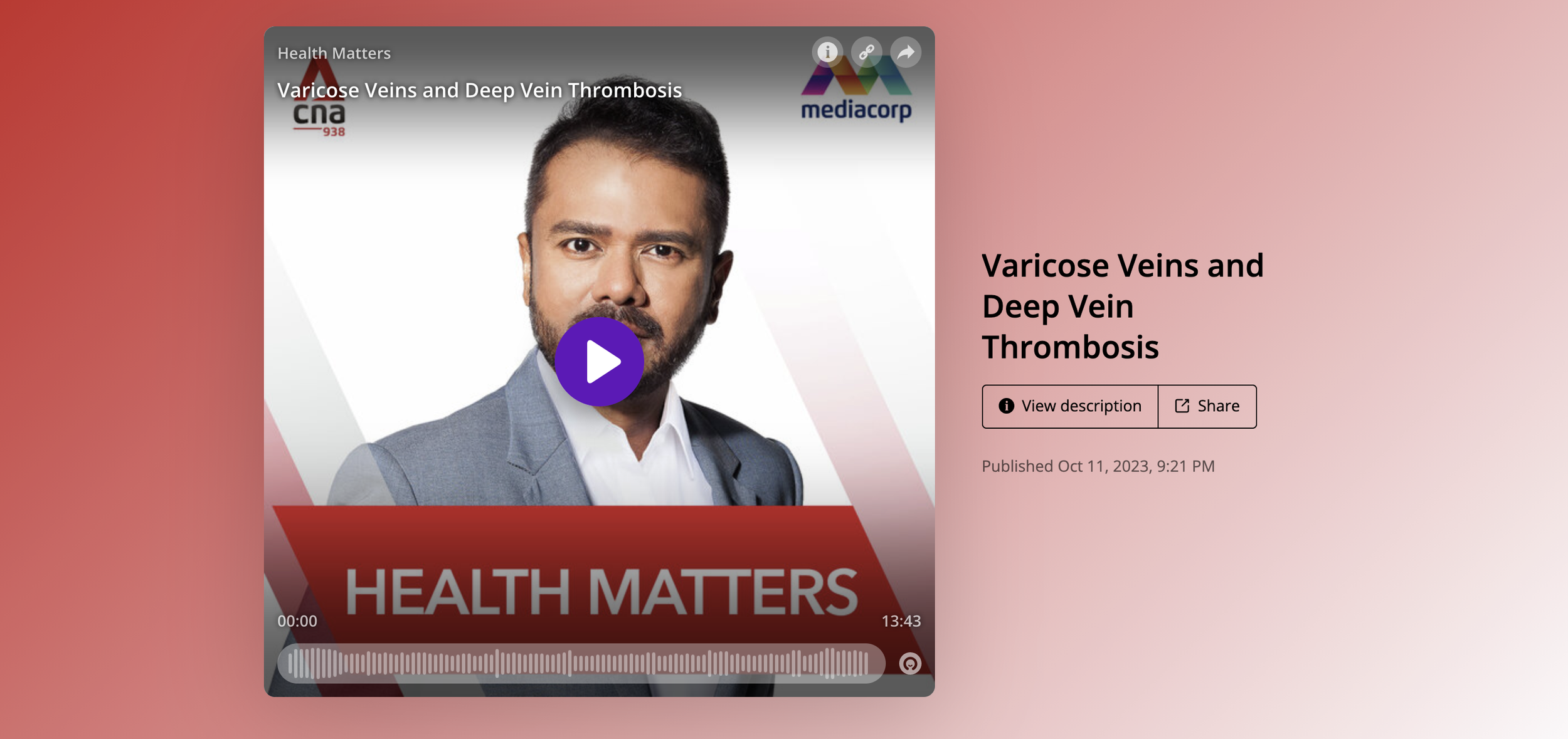
Channel NewsAsia Health Matters podcast featuring Dr Andrew Choong discussing varicose veins and deep vein thrombosis
Best in Singapore – Directory Listing
Dr Choong was featured by the directory Best in Singapore in its listing of vascular surgeons (feature now archived).
