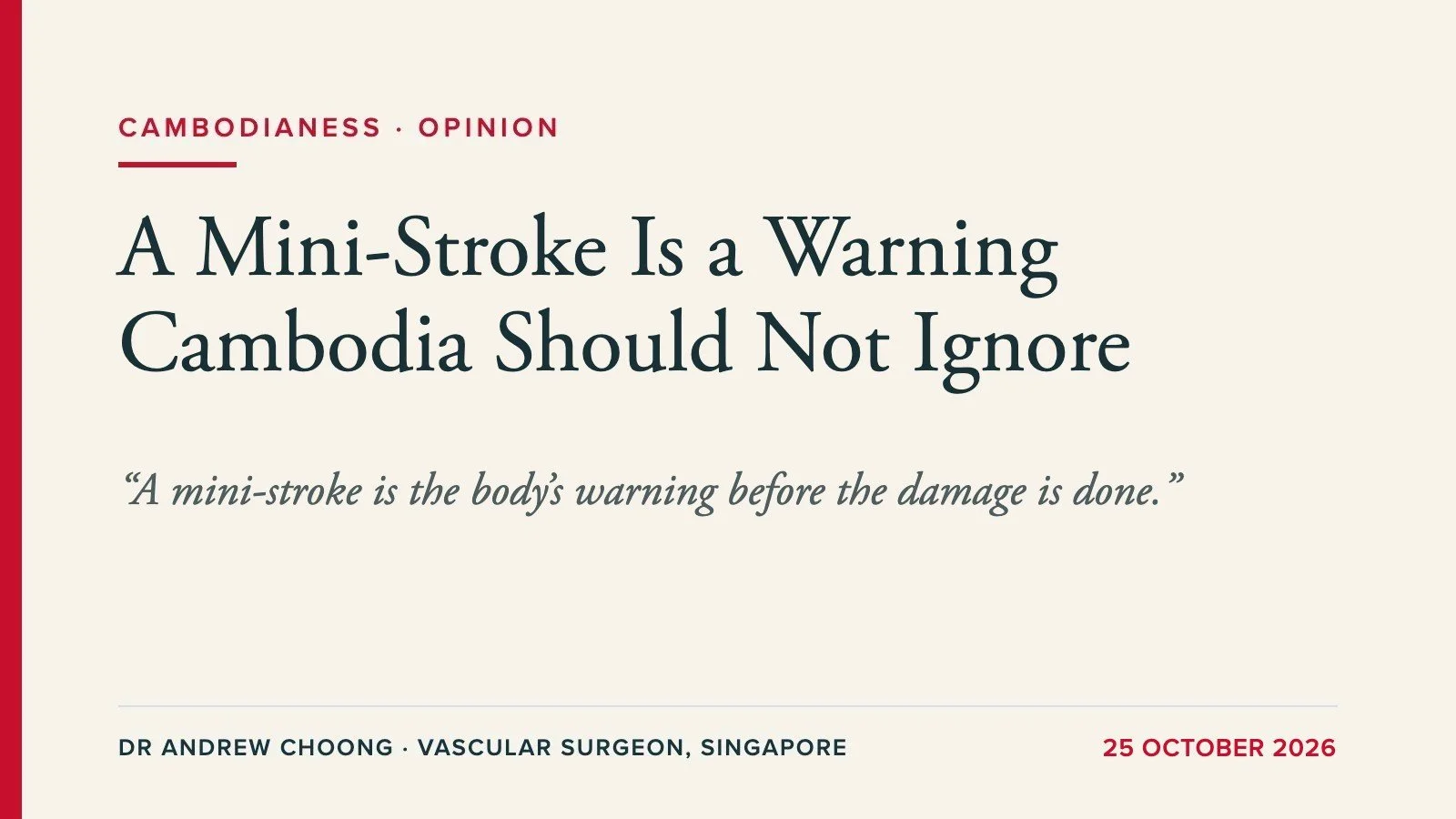
A Mini-Stroke Is a Warning: What It Means for Families in Cambodia
For World Stroke Day, Dr Andrew Choong wrote for Cambodianess on the mini-stroke that passes in minutes, why it needs attention the same day, and three steps within reach in Cambodia.
October 29 is World Stroke Day. Ahead of it, Cambodianess has published my opinion piece on the transient ischaemic attack: the mini-stroke whose symptoms pass within minutes and which families understandably put down to tiredness, the heat or something eaten. It is my third article for Cambodianess this month. This post sets out the argument for families in Cambodia, and for readers in Singapore who travel or have relatives there.
Why does stroke matter so much in Cambodia?
The latest Global Burden of Disease profile ranks stroke first among all causes of years of healthy life lost in Cambodia. The 2023 national STEPS survey points to the reasons: nearly one in five adults has high blood pressure, one in five smokes, and average salt intake is about 9.5 grams a day, almost double the recommended limit. More than half of those with high blood pressure were not on any treatment. Each of these risk factors is known and can be changed.
What is a mini-stroke?
For a few minutes, sometimes an hour, part of the brain loses its blood supply. One side of the face droops, an arm goes weak, speech becomes slurred or stops, or the vision in one eye goes dark like a curtain. Then it passes and the person feels normal again. A transient ischaemic attack is a stroke that stopped by itself, and it is one of the clearest warnings that a full stroke may follow. I explain the link with the arteries in the neck in a short video on TIA and carotid artery disease, and the warning signs in a World Stroke Day video.
Why do the first days ma tter?
In a registry of almost 4,800 patients across 21 countries, one in twenty had a stroke within a year of their TIA, even though most were seen by a specialist within 24 hours. In the EXPRESS study in Oxford, when patients were assessed and started on treatment the same day instead of waiting for an appointment, the risk of a stroke over the next 90 days fell from about 10 per cent to about 2 per cent. The medicines and tests were the same as before. What changed was how soon they began.
Where do the carotid arteries come in?
The two carotid arteries in the neck carry most of the blood to the brain. With age, smoking, high blood pressure and diabetes, plaque builds up inside them, as it does in the arteries of the heart and legs. A fragment of that plaque can break off and lodge in the brain, and about one in twelve ischaemic strokes is caused this way.
A narrowed carotid artery can be found with a neck ultrasound, a painless twenty-minute scan that needs no injection and shows how narrow the artery is and how the plaque looks. Where the narrowing is severe and has already caused symptoms, an operation to clear the artery, or in selected patients a stent, lowers the risk of a major stroke; both are described on the carotid surgery and stenting page. Timing matters here as well. In the pooled analysis of the major trials, five patients needed surgery within two weeks of their symptoms to prevent one stroke; after twelve weeks the number was 125.
“A mini-stroke is the body’s warning before the damage is done.”
What is within reach in Cambodia?
Most people in Cambodia who have a TIA will not see a neurologist within 24 hours, and that will take time to change. Three things are possible now.
- Families knowing what to look for. The FAST check: Face (has one side dropped?), Arms (can both be raised and held?), Speech (is it slurred or missing?) and Time. If any of these appear, even briefly and even if they have already gone, the person should be seen the same day.
- The first doctor starting treatment. The treatment behind the Oxford result was not high technology: an aspirin-type medicine, a cholesterol-lowering medicine, blood pressure control and a prompt look at the carotid arteries. A provincial hospital with an ultrasound machine can do the scan.
- Knowing your blood pressure. A blood pressure check takes a minute and costs very little. For anyone over 40 who smokes, has diabetes or has a parent who had a stroke, it belongs in every visit to a health centre. I talk about this in a short video on blood pressure and vascular health.
What should you do if it happens?
If stroke symptoms are happening now, go to the nearest hospital emergency department at once; in Phnom Penh the ambulance number is 119, and in Singapore it is 995. If the symptoms have already passed, a same-day medical assessment is still the safest course, even if the person feels entirely well.
Read the full article
The article, “A Mini-Stroke Is a Warning Cambodia Should Not Ignore”, was published by Cambodianess on 25 October 2026. For World Stroke Day I also wrote for readers in Malaysia, in CodeBlue, and in Singapore, in a letter to The Straits Times Forum. All are listed on the press page. Last year's World Stroke Day post covers carotid artery disease and stroke prevention in more detail.
Preparing for a vascular review
If a carotid scan after a mini-stroke has shown a narrowing, or you would like a second opinion on one, bring the scan report and images, a list of current medicines and recent blood test results. Patients travelling from Cambodia and elsewhere in the region will find practical details on the international patients page, and can reach the clinic through the contact page.